How to Automate Customer Onboarding for UK SMEs: Streamline Processes and Boost Retention
Imagine slashing your customer onboarding time from days to minutes, freeing up your UK SME team to focus on growth instead of admin drudgery.
Streamline Your Customer Journey from Day One
Customer onboarding automation for UK SMEs is transforming how businesses welcome new clients, reducing manual errors and boosting retention rates.
Manual processes often lead to delays, data silos, and frustrated customers, costing SMEs valuable time and revenue.
This guide explores practical steps to automate onboarding, centralise data via CRM integrations, and ensure compliance while scaling efficiently.
The Challenges of Manual Customer Onboarding for UK SMEs
For many UK SMEs, manual customer onboarding is a significant bottleneck. Small teams spend hours chasing documents, sending individual welcome emails, and manually entering data into spreadsheets or basic CRMs. This repetitive admin not only drains resources but also delays the point at which new customers can start deriving value from your services.
Manual onboarding can result in 20-30% higher early churn rates for SMEs, as delays and errors damage first impressions and trust.
- Time-intensive admin: Hours per customer on emails, calls, and data entry.
- Error-prone processes: Manual handling leads to data inaccuracies and compliance risks.
- Delayed communications: Customers wait days for setup, eroding trust.
- Scalability limits: Inability to handle volume spikes without hiring more staff.
- Higher churn rates: Frustrated new customers disengage before full onboarding.
Key Benefits of Customer Onboarding Automation for UK SMEs
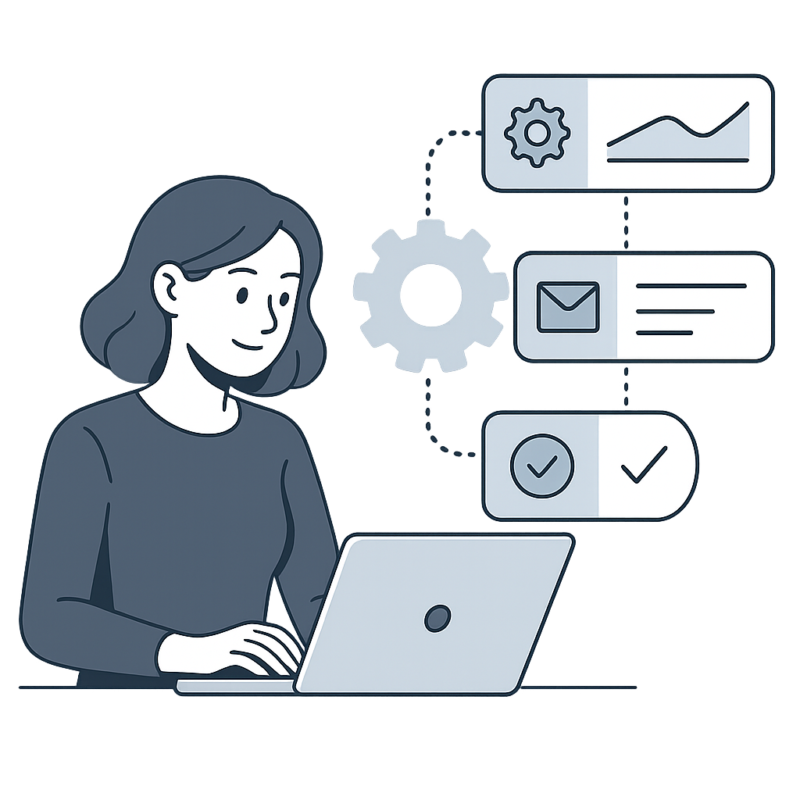
Customer onboarding automation for UK SMEs delivers immediate relief by automating repetitive tasks, allowing teams to focus on high-value activities like sales and service delivery. Workflows trigger instantly upon sign-up, sending personalised welcome sequences and collecting documents without human intervention.
Beyond efficiency, automation personalises the customer experience with tailored content based on sign-up data, fostering loyalty from the start. Seamless data centralisation reduces silos, providing a single view of customer progress and enabling proactive support.
SMEs report onboarding times reduced by up to 80%, with retention improvements of 15-25% due to consistent, timely engagements. This not only cuts costs but also scales effortlessly as customer volume grows.
SMEs automating onboarding often see 50-70% admin time reduction in the first month, with retention uplift contributing to 10-20% annual revenue growth.
- Drastically reduced onboarding time: From days to minutes.
- Improved data accuracy: Automated entry minimises human errors.
- Enhanced customer experience: Personalised, timely communications.
- Boosted retention: Proactive follow-ups prevent drop-offs.
- Scalable growth: Handles increased volume without extra staff.
- Measurable ROI: Quick wins in time savings and revenue protection.
Essential Components of Automated Onboarding Workflows
Effective customer onboarding automation for UK SMEs relies on a few key components working in harmony. At the core is an automated welcome sequence: triggered by form submission or purchase, it sends a series of emails outlining next steps, sharing resources, and requesting information.
Document collection portals allow secure uploads without back-and-forth emails. Task assignments notify internal teams automatically when actions are needed, such as account setup or compliance checks. Progress tracking dashboards give visibility into each customer’s journey, flagging stalls for intervention.
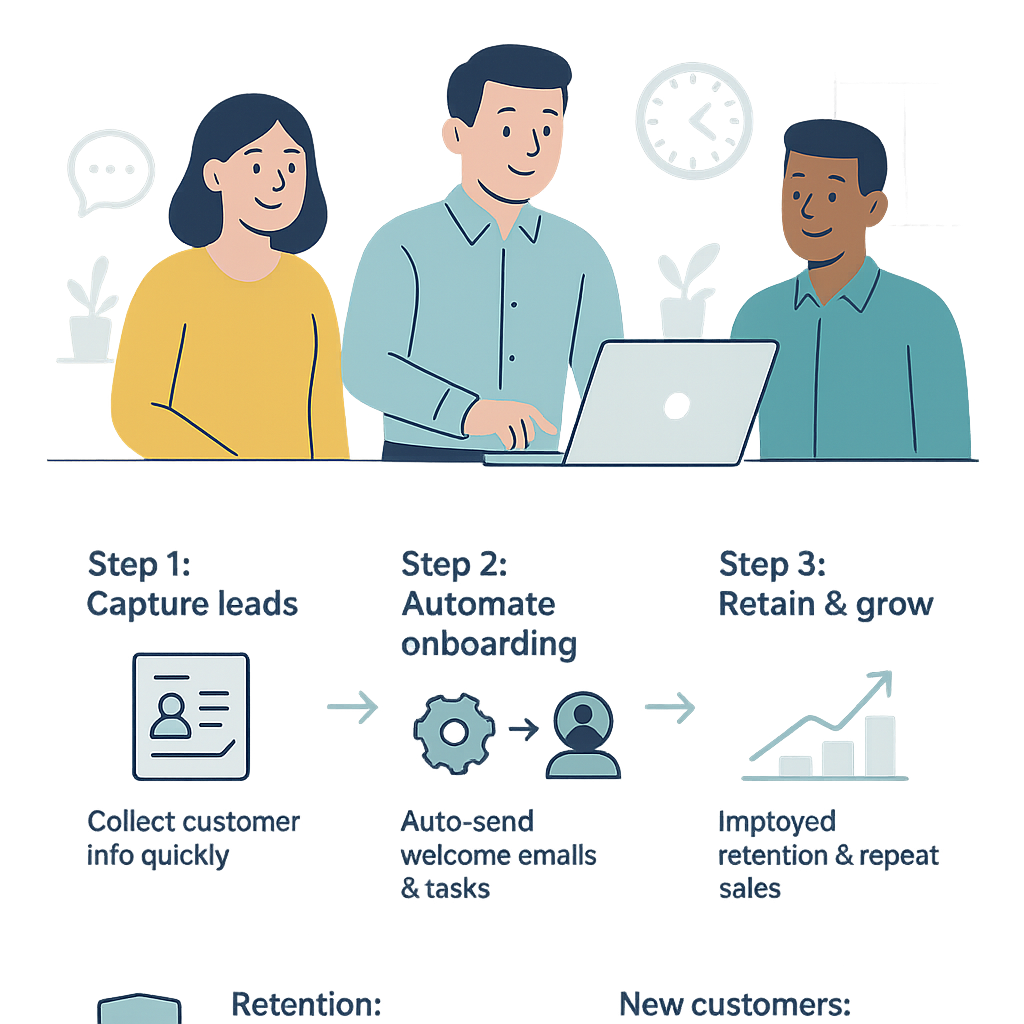
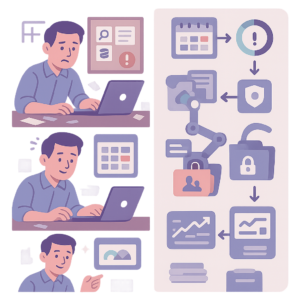
These elements form a linear yet flexible workflow: sign-up → welcome → docs → verification → activation → follow-up. No-code tools make this accessible, visualising the flow like a flowchart for easy adjustments.
1. Trigger (sign-up) → 2. Welcome email → 3. Doc request → 4. Internal tasks → 5. Activation → 6. Retention follow-up.
- Automated welcome emails/sequences: Immediate, personalised engagement.
- Secure document collection: Forms and portals for essential paperwork.
- Task automation: Assign roles to team members on triggers.
- Progress tracking: Dashboards monitoring completion stages.
- Follow-up nudges: Reminders for incomplete steps or celebrations on completion.
Step-by-Step Guide to Implementing Customer Onboarding Automation
Implementing customer onboarding automation starts with understanding your current process. Document every step from sign-up to full activation, noting pain points and time sinks. This baseline helps prioritise automation targets.
Choose user-friendly, no-code platforms like Zapier, Make, or native CRM tools such as HubSpot’s workflows, which integrate easily without developers. Map your new automated flow, connecting triggers to actions.
Build incrementally: start with welcome emails, add document collection, then tasks. Test rigorously with dummy data, simulating various scenarios. Launch to a small cohort, monitor metrics, and iterate based on feedback for optimal results.
- 1. Assess current process: Time it and note bottlenecks.
- 2. Select tools: Opt for no-code options compatible with your CRM.
- 3. Design workflow: Sketch triggers, actions, and conditions.
- 4. Build and configure: Connect apps and set up sequences.
- 5. Test thoroughly: Use test accounts and edge cases.
- 6. Launch and monitor: Track completion rates and feedback.
- 7. Optimise: Refine based on data and user input.
Skip testing at your peril—live errors can damage customer trust and require manual fixes.
Integrating CRM and Other Tools for Seamless Onboarding
Centralising data through CRM integration is pivotal for customer onboarding automation for UK SMEs. Syncing sign-up forms directly to your CRM like Pipedrive or Salesforce ensures instant record creation, eliminating duplicate entry.
Combine with email platforms (e.g., Mailchimp), payment gateways (Stripe), and document tools (Google Drive or DocuSign). Zapier acts as the glue, automating flows such as ‘new Stripe payment → update CRM status → send welcome via Mailchimp → request docs via Typeform’.
Common pitfalls include sync delays or field mismatches; verify mappings and set up error notifications. Regular audits keep data clean, enabling advanced features like segmented follow-ups based on onboarding progress.
CRM (HubSpot/Pipedrive) + Zapier + Mailchimp + Stripe + Google Workspace: Covers 90% of SME needs.
- CRM + Email: HubSpot workflows for personalised sequences.
- CRM + Payments: Stripe webhooks updating deal stages.
- CRM + Docs: Automated sharing post-verification.
- Multi-tool via Zapier: Connect 100+ apps seamlessly.
- Verification steps: Test syncs and monitor logs.
Risks, Compliance, and Best Practices for Onboarding Automation
While powerful, customer onboarding automation carries risks such as misfiring workflows sending duplicate emails or failing to collect critical data. Integration glitches can cause data silos or inaccuracies, impacting reporting and customer service.
Compliance is key: ensure opt-in consents, secure data handling, and audit trails for customer information. Best practices include thorough testing, customer feedback loops, and fallback manual processes for exceptions.
Ongoing monitoring prevents drift: review completion rates weekly, update for tool changes, and train staff on oversight. This balanced approach maximises benefits while minimising disruptions.
- Test all scenarios, including failures.
- Secure customer data with encryption and consents.
- Monitor KPIs: completion time, error rates, satisfaction.
- Have manual overrides for edge cases.
- Document workflows for team handovers.
- Regular audits for compliance and performance.
Always obtain explicit customer consent for data processing and communications to meet regulatory standards—non-compliance risks fines.
Take Control of Your Customer Onboarding Today
Customer onboarding automation for UK SMEs isn’t just a nice-to-have—it’s a strategic move to reclaim time, delight customers, and fuel sustainable growth. By addressing manual bottlenecks with smart workflows and integrations, businesses can create frictionless experiences that drive loyalty and revenue.
Start small with core components like welcome sequences and document automation, then expand as confidence builds. Remember to prioritise testing and compliance for long-term success.
If your SME is ready to streamline onboarding, consider a professional review to tailor solutions to your unique processes—efficient onboarding sets the foundation for thriving customer relationships.
Key points
- Manual customer onboarding drains time and risks retention for UK SMEs—automation streamlines it efficiently.
- Customer onboarding automation for UK SMEs integrates CRM, emails, and workflows to cut delays and personalise experiences.
- Start with essential components like automated welcomes and document collection for quick wins.
- Always test integrations and monitor for compliance to avoid data issues.
- Implementing these steps positions your SME for scalable growth and higher customer satisfaction.
Frequently asked questions
Is customer onboarding automation suitable for small UK businesses?
Yes, customer onboarding automation is highly suitable for UK SMEs, including small teams with limited resources. No-code platforms make it accessible without needing developers, allowing you to automate repetitive tasks like welcome emails and document collection based on your specific processes, data quality, and existing tools.
How long does it take to set up customer onboarding automation?
The setup time for customer onboarding automation varies depending on the complexity of your current processes, the tools you use, and the level of customisation required. Simple workflows can be implemented in a few days, while more integrated systems might take weeks; thorough testing is essential to ensure reliability.
Will onboarding automation work with my existing CRM and tools?
Most customer onboarding automation solutions integrate seamlessly with popular CRMs like HubSpot, Pipedrive, or Salesforce, as well as email platforms and payment gateways via no-code tools such as Zapier. Compatibility depends on your specific tech stack, so checking integration options upfront is advisable.
What are the GDPR risks with customer onboarding automation?
GDPR risks in customer onboarding automation primarily involve secure data handling, obtaining explicit consents, and maintaining audit trails. By implementing proper opt-ins, encryption, and compliance checks in your workflows, UK SMEs can mitigate these risks effectively, though regular reviews are necessary.
What happens if the automation breaks during onboarding?
If an automation fails, having manual fallback processes and error notifications in place ensures quick resolution without disrupting customer experience. Monitoring tools help detect issues early, and testing scenarios beforehand minimises the chances of breakdowns in live operations.
Ready to Streamline Your Onboarding?
Get expert guidance from Business Automations UK to review your current processes and implement tailored customer onboarding automation. Start saving time and boosting retention today.
This article is for general information only. It is not legal, financial, or compliance advice. If you are unsure about GDPR, HMRC, or regulatory obligations, speak to a qualified professional or reach out to us for more information.
Related Posts
Should I Use AI to Build My Website? Pros, Cons & Costs

How to Automate Client Onboarding for UK SMEs: A Practical Guide
How to Automate Insurance Claim Processing for UK SMEs: Streamline Approvals & Reduce Admin
How to Automate Subscription Billing for UK SMEs: Reduce Churn & Streamline Recurring Payments
How to Automate Health and Safety Incident Reporting for UK SMEs: Streamline Compliance & Reduce Liability
How to Automate Purchase Order Approval Workflows for UK SMEs: Cut Delays & Boost Compliance
How to Automate Vendor Invoice Processing for UK SMEs: Speed Up Payments & Reduce Errors
How to Automate Invoice Payment Chasing for UK Small Businesses: A Proven 5-Step Guide
How to Automate Supplier Onboarding for UK SMEs: Streamline Procurement & Ensure Compliance

How to Automate Inventory Management for UK SMEs: Reduce Stock Errors & Boost Efficiency
How to Automate Risk Assessment Workflows for UK SMEs: A Compliance Guide
How to Automate GDPR Data Retention Policies for UK SMEs: Delete Personal Data Lawfully
- Should I Use AI to Build My Website? Pros, Cons & Costs
- How to Automate Client Onboarding for UK SMEs: A Practical Guide

- How to Automate Insurance Claim Processing for UK SMEs: Streamline Approvals & Reduce Admin
- How to Automate Subscription Billing for UK SMEs: Reduce Churn & Streamline Recurring Payments
- How to Automate Health and Safety Incident Reporting for UK SMEs: Streamline Compliance & Reduce Liability