How to Scale Your UK SME Using Automation: 5 High-Impact Workflows
Struggling to grow your UK SME without drowning in manual admin and hiring sprees? Scale UK SME automation with these 5 high-impact workflows to handle expansion efficiently.
The Growth Challenge for UK SMEs
Many UK SMEs hit a wall when scaling UK SME automation is overlooked, as manual processes can’t keep up with surging demand, leading to delays, errors, and frustrated teams.
This creates unnecessary admin burdens, compliance risks, and missed revenue opportunities, affecting owners, managers, and operations.
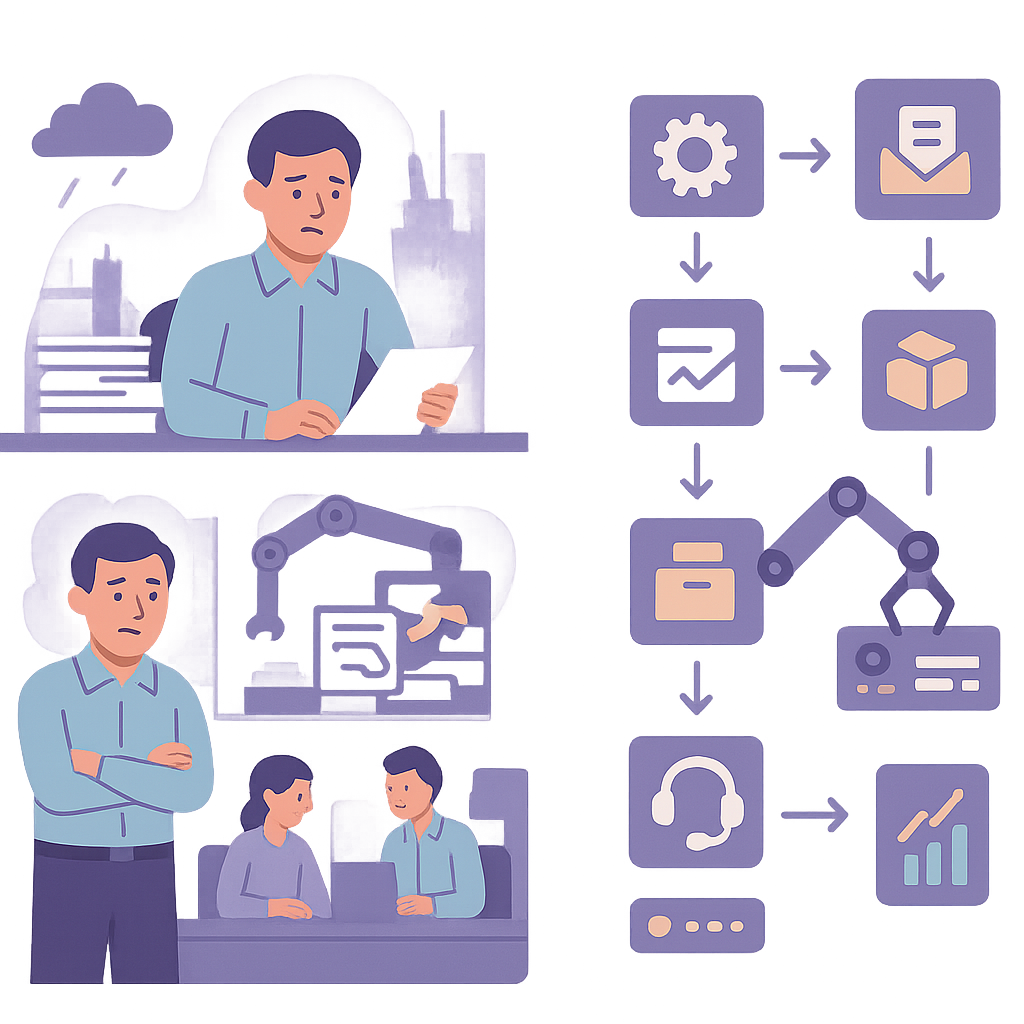
In this post, we’ll explore 5 proven workflows to automate key processes, enabling sustainable growth without excessive staffing.
Common Scaling Challenges Faced by UK SMEs
As UK SMEs expand, they often encounter significant hurdles that manual processes simply cannot handle efficiently. Order volumes increase, customer enquiries multiply, and administrative tasks pile up, leading to bottlenecks that slow down operations and erode profitability.
- Overwhelming repetitive admin tasks eating into productive time.
- Error-prone manual processes leading to costly mistakes.
- Inability to handle increased volumes without proportional staff growth.
- Rising operational costs and compliance risks as business scales.
One major issue is the overwhelming admin load. Teams spend hours on repetitive tasks like data entry, chasing payments, and generating reports, diverting time from core business activities such as innovation and customer service.
Errors become more frequent with scale. Manual handling of leads or orders increases the risk of mistakes, such as incorrect invoicing or lost customer details, which can damage reputation and lead to financial losses.
Scalability limits hit hard too. What works for 100 customers fails at 1,000, resulting in backlogs, delayed deliveries, and unhappy clients. Rising costs from overtime or rushed hiring further strain budgets.
Real UK SME scenarios abound: e-commerce businesses face order fulfilment delays during peak seasons, service firms struggle with support tickets, and all grapple with compliance under GDPR and HMRC rules amid growing data volumes.

Ignoring these challenges can lead to compliance breaches under UK regulations like GDPR, financial losses from errors, and stunted growth due to team burnout.
Why Scale UK SME Automation is Essential
Scale UK SME automation transforms these challenges into opportunities by streamlining operations, reducing errors, and freeing resources for growth. It allows businesses to handle higher volumes without linearly increasing headcount.
Efficiency gains are immediate: automated workflows process tasks in seconds that once took hours, boosting throughput and team morale. Cost savings follow, as you avoid unnecessary hires and overtime.
Error reduction is critical, especially with UK-specific regulations. Automation ensures consistent data handling, minimising risks under GDPR and HMRC guidelines.
Moreover, automation provides scalability on demand. As your SME grows, workflows adapt seamlessly, supporting expansion without operational disruption. High-level examples show businesses doubling output with minimal additional investment.
Adopting scale UK SME automation isn’t just beneficial—it’s essential for competitive edge in a fast-paced market.

Automation can yield up to 30-50% time savings on repetitive tasks, based on industry benchmarks, enabling focus on strategic growth.
Workflow 1: Automating Lead Generation and Qualification
Lead generation is the lifeblood of growth, but manual qualification is time-consuming. Scale UK SME automation starts here by capturing leads from website forms, emails, or ads and automatically scoring them based on criteria like interest level or company size.
Integrate tools such as Zapier or Make to connect landing pages with your CRM (e.g., HubSpot or Pipedrive). Incoming leads trigger qualification: assign scores, segment hot leads, and notify sales teams instantly.
This handles 10x more leads without extra staff. For UK SMEs, ensure GDPR compliance by auto-tagging consent data and archiving unqualified leads securely.
The result? Faster response times, higher conversion rates, and a scalable sales pipeline that grows with your business.
- Capture leads via web forms or social media integrations.
- Auto-score based on predefined criteria (e.g., budget, urgency).
- Route qualified leads to CRM and notify teams.
- Archive or nurture low-quality leads automatically.
Always include consent mechanisms in lead forms and ensure automated data processing complies with UK GDPR requirements.
Workflow 2: Streamlining Order Processing and Fulfilment
Order processing bottlenecks can halt growth. Automate from receipt to dispatch: when an order hits your platform (Shopify, WooCommerce), trigger inventory checks, payment verification, and shipping label generation.
Integrate with UK logistics like Royal Mail or DPD via APIs. Update customers automatically with status notifications, reducing enquiries and errors.
This workflow cuts fulfilment time from days to hours, scales to peak demands (e.g., Black Friday), and minimises stock discrepancies.
UK SMEs benefit from seamless e-commerce scaling without warehouse chaos.
- Receive order and validate payment.
- Check stock levels in real-time.
- Generate shipping labels and notify carriers.
- Send automated customer updates and confirm delivery.
Popular integrations include Shopify with Royal Mail, ensuring compliant labelling and tracking for UK deliveries.
Workflow 3: Automating Invoicing and Payments
Finance admin drains resources. Automate invoicing post-order: generate bills via Xero or QuickBooks APIs, send via email, and chase overdue payments with reminders.
Reconcile payments automatically against bank feeds, flagging discrepancies. This improves cashflow visibility and HMRC compliance for VAT reporting.
Scale to thousands of invoices monthly without a larger finance team, reducing late payments and errors.
Essential for UK SMEs eyeing rapid expansion.
- Create and send invoices automatically upon order completion.
- Monitor payments and send gentle reminders.
- Reconcile with bank statements.
- Generate compliance reports for HMRC.
Ensure automated reports align with Making Tax Digital requirements to avoid penalties.
Workflow 4: Optimising Customer Support Workflows
Customer support scales poorly manually. Automate ticket routing in tools like Zendesk or Freshdesk: classify enquiries by keywords, assign to agents, and send auto-responses.
Incorporate chatbots for FAQs, escalating complex issues. GDPR-safe data handling ensures privacy.
Free agents for high-value interactions as volumes grow, maintaining satisfaction without extra hires.
- Auto-categorise and route support tickets.
- Deploy AI chatbots for common queries.
- Send personalised auto-replies.
- Escalate unresolved issues to humans.
Start with simple FAQ bots integrated via no-code platforms, training on your knowledge base.
Workflow 5: Automating Reporting and Business Insights
Manual reporting is outdated. Automate KPI dashboards pulling data from CRM, sales, and finance via Google Data Studio or Power BI connectors.
Schedule daily/weekly reports emailed to managers, highlighting trends like lead conversion or revenue growth.
Real-time insights empower UK SME leaders to pivot quickly, without spreadsheet drudgery.
- Connect data sources to visualisation tools.
- Automate KPI calculations and dashboards.
- Distribute scheduled reports.
- Alert on key thresholds (e.g., low stock).
Use secure connectors and role-based access to protect sensitive business data under UK standards.
Implementing These Workflows in Your UK SME
Start by auditing current processes to identify high-impact areas. Choose no-code tools like Zapier, Make, or native platform automations for quick wins.
Test in stages: pilot one workflow, monitor performance, then scale. Prioritise UK compliance—GDPR for data, HMRC for finance.
Train your team minimally, as these tools are user-friendly. Measure success via time saved, error rates, and ROI indicators.
Build iteratively for sustainable scale UK SME automation.
- Audit processes and prioritise workflows.
- Select compliant, scalable tools.
- Test small, iterate based on data.
- Monitor KPIs and refine continuously.
Week 1: Audit & plan. Week 2-4: Build & test one workflow. Ongoing: Monitor & expand.
Ready to Scale Your UK SME with Automation
Scaling your UK SME doesn’t require massive hires or chaos—scale UK SME automation with these 5 workflows delivers efficiency and reliability.
From leads to insights, automation handles growth pains, ensuring compliance and competitiveness.
Assess your operations today and consider expert advice to implement seamlessly for lasting success.
Key points
- Scale UK SME automation resolves manual bottlenecks, enabling growth without proportional staff increases.
- The 5 workflows—leads, orders, invoicing, support, and reporting—target high-impact areas for immediate efficiency gains.
- Prioritise compliant, no-code tools to automate safely and measure ROI quickly.
- UK SMEs ignoring automation risk errors, delays, and compliance issues amid expansion.
- Start implementing one workflow today to build momentum for sustainable scaling.
- Seek professional review to tailor automations to your unique needs.
Frequently asked questions
Is scale UK SME automation suitable for small businesses?
Yes, scale UK SME automation is highly suitable for small businesses as it leverages no-code tools that are straightforward to implement and scale alongside your growth. The suitability depends on factors such as your current systems, process clarity, and data quality, allowing even modest teams to handle increased volumes efficiently.
How long does it take to set up automation workflows for scaling?
The time required to set up automation workflows varies depending on the complexity of your processes, the tools chosen, and the need for testing and compliance checks. Many UK SMEs can pilot their first workflow within a few weeks, with full implementation building iteratively.
Will these automations integrate with my existing business tools?
Most scale UK SME automation workflows integrate seamlessly with popular tools like Xero, Shopify, HubSpot, and Zendesk via platforms such as Zapier or Make. Compatibility hinges on API availability and your specific setup, enabling you to build on what you already use.
What are the GDPR risks when automating for UK SMEs?
GDPR risks can be minimised by incorporating consent mechanisms, secure data handling, and audit trails in your automations. Always ensure compliance with ICO guidelines, particularly for lead data and customer interactions, to protect privacy during scaling.
What should I do if an automation workflow fails?
Include monitoring alerts and fallback manual processes in your setup to handle failures promptly. Regular reviews and testing help prevent disruptions, ensuring your operations remain reliable as your SME scales.
Ready to Scale Your UK SME with Automation?
Get expert guidance from Business Automations UK to audit your processes and implement these high-impact workflows tailored to your business. Start your journey to efficient growth today.
This article is for general information only. It is not legal, financial, or compliance advice. If you are unsure about GDPR, HMRC, or regulatory obligations, speak to a qualified professional or reach out to us for more information.
Related Posts
Should I Use AI to Build My Website? Pros, Cons & Costs

How to Automate Client Onboarding for UK SMEs: A Practical Guide
How to Automate Insurance Claim Processing for UK SMEs: Streamline Approvals & Reduce Admin

How to Automate Subscription Billing for UK SMEs: Reduce Churn & Streamline Recurring Payments
How to Automate Health and Safety Incident Reporting for UK SMEs: Streamline Compliance & Reduce Liability
How to Automate Purchase Order Approval Workflows for UK SMEs: Cut Delays & Boost Compliance

How to Automate Vendor Invoice Processing for UK SMEs: Speed Up Payments & Reduce Errors
How to Automate Invoice Payment Chasing for UK Small Businesses: A Proven 5-Step Guide
How to Automate Supplier Onboarding for UK SMEs: Streamline Procurement & Ensure Compliance

How to Automate Inventory Management for UK SMEs: Reduce Stock Errors & Boost Efficiency
How to Automate Risk Assessment Workflows for UK SMEs: A Compliance Guide
How to Automate GDPR Data Retention Policies for UK SMEs: Delete Personal Data Lawfully
- Should I Use AI to Build My Website? Pros, Cons & Costs
- How to Automate Client Onboarding for UK SMEs: A Practical Guide

- How to Automate Insurance Claim Processing for UK SMEs: Streamline Approvals & Reduce Admin
- How to Automate Subscription Billing for UK SMEs: Reduce Churn & Streamline Recurring Payments
- How to Automate Health and Safety Incident Reporting for UK SMEs: Streamline Compliance & Reduce Liability