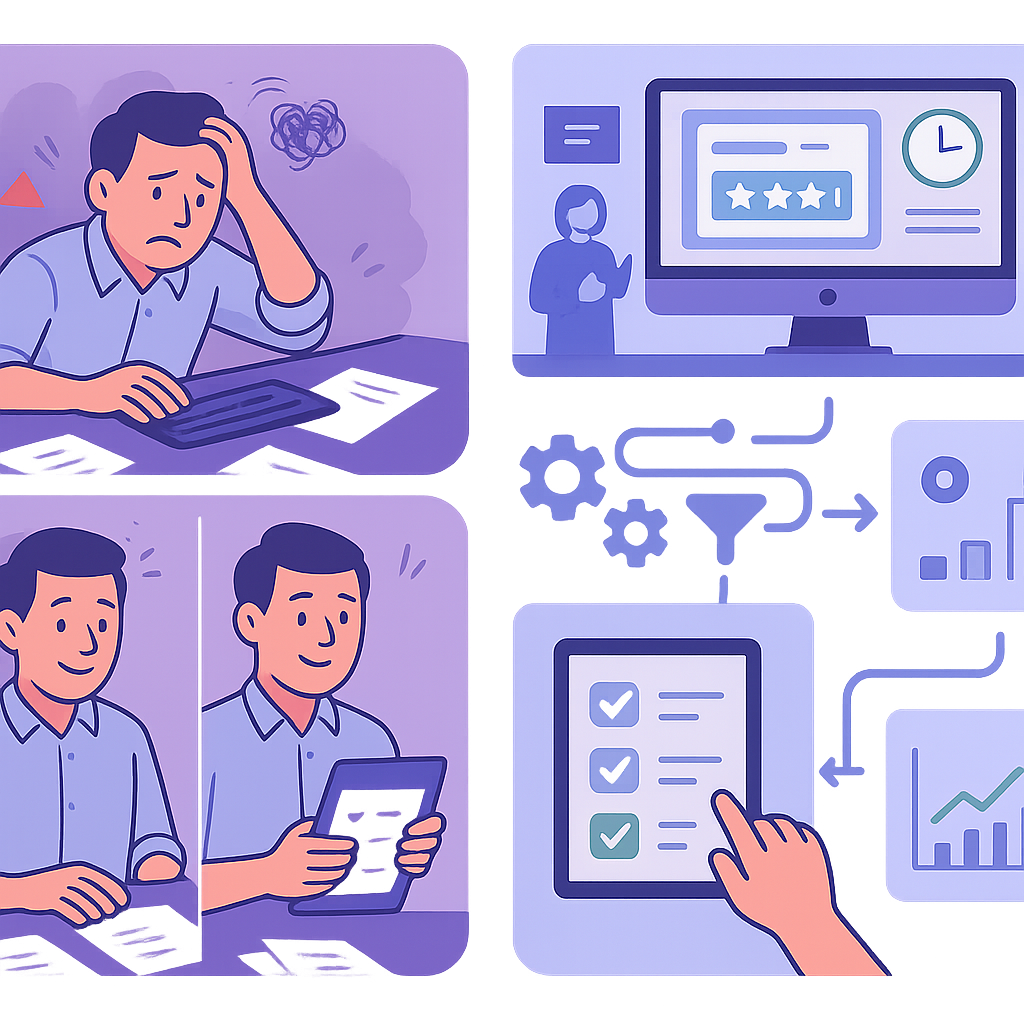
Why UK SMEs Need Customer Feedback Automation Now
Drowning in scattered customer reviews, emails, and social comments that steal hours from your UK SME team every week?
Why UK SMEs Need Customer Feedback Automation Now
Customer feedback automation UK SMEs is revolutionising how small and medium enterprises handle reviews, turning a time-consuming chore into a strategic advantage. With feedback pouring in from emails, social media, Google reviews, and more, manual management leads to delays, oversights, and missed opportunities to build reputation.
This guide breaks down the challenges, benefits, and practical steps for automating customer feedback management, helping you reduce admin burden while staying GDPR-compliant.
Whether you’re a retailer, service provider, or professional firm, learn how to centralise, analyse, and respond efficiently to boost customer satisfaction and loyalty.
The Challenges of Manual Customer Feedback Management
Managing customer feedback manually is a relentless task for UK SMEs. Feedback streams in from diverse sources like Google My Business, Trustpilot, Facebook, email surveys, and direct messages. Business owners and small teams often spend hours each week logging into multiple platforms, searching for new comments, and compiling them into spreadsheets or notes.
This fragmented approach leads to significant inefficiencies. Switching between tabs and apps wastes valuable time, while the sheer volume can overwhelm limited staff resources. A single overlooked negative review on a high-traffic site can snowball into reputational damage before it’s noticed.
As your SME grows, so does the feedback volume, but manual processes don’t scale. What starts as a manageable 20 reviews a week quickly becomes 100 or more, leading to burnout, inconsistent responses, and missed opportunities to engage positively with customers. In competitive UK markets, this admin overload directly impacts growth.
- Hours lost daily switching between review sites, social media, and email.
- High risk of missing urgent negative feedback that harms online reputation.
- Inconsistent or delayed responses erode customer trust.
- Scalability issues prevent focus on core business activities as volume grows.
- Manual data entry prone to errors, complicating trend analysis.
Failing to spot and address negative feedback promptly can lead to viral complaints on social media, lost customers, and long-term harm to your SME’s online reputation. Always prioritise timely monitoring.
Key Benefits of Customer Feedback Automation for UK SMEs
Customer feedback automation UK SMEs delivers immediate value by streamlining processes that were once chaotic. Centralised dashboards consolidate all feedback into one view, eliminating the need to juggle multiple logins and reducing admin time dramatically.
Beyond efficiency, automation enables proactive reputation management. Quick, consistent responses to reviews improve visibility in search results and build trust. AI-driven insights reveal trends, helping SMEs make data-informed decisions to enhance services.
For UK businesses, staying ahead means leveraging tools that also simplify GDPR compliance through built-in consent tracking and secure data handling. The result? Happier customers, stronger loyalty, and more time for growth-focused activities.
- Significant time savings: reclaim 10-20 hours weekly from manual monitoring.
- Faster response times: achieve 80% quicker replies, boosting satisfaction scores.
- Enhanced reputation: proactive engagement turns negative feedback into positives.
- Actionable insights: automated reports highlight trends for service improvements.
- GDPR ease: compliant tools reduce legal risks and audit burdens.
Many UK SMEs report halving their feedback admin time within weeks of implementing centralised automation, freeing staff for customer-facing roles.
Centralising Customer Feedback from Multiple Sources
The first step in effective customer feedback automation UK SMEs is centralisation. By aggregating data from all sources into one dashboard, you gain complete oversight without constant manual checks.
Popular tools like Zapier, Make (formerly Integromat), or dedicated platforms such as ReviewTrackers and BirdEye integrate seamlessly with Google Reviews, Facebook, Trustpilot, email providers like Gmail or Outlook, and survey tools like Typeform. Set up automated triggers to pull new feedback in real-time.
Best practices include mapping feedback fields consistently (e.g., customer name, rating, comment) to avoid duplication, and using filters to prioritise high-impact sources like Google, which influences local search rankings for UK businesses.
- Choose no-code integrators like Zapier for easy connections.
- Set real-time triggers for new reviews or comments.
- Deduplicate entries using unique identifiers like review IDs.
- Test integrations with sample data before going live.
- Select a central platform (e.g., Google Sheets, Airtable, or dedicated review tool).
- Connect primary sources: Google, Facebook, Trustpilot, email.
- Configure triggers for instant notifications.
- Verify data accuracy and remove duplicates.
- Schedule daily backups for compliance.
Automating Feedback Analysis and Sentiment Detection
Once centralised, automate analysis to extract value quickly. AI-powered sentiment detection tools classify feedback as positive, neutral, or negative, scoring urgency based on keywords like ‘urgent’ or ‘disappointed’.
Platforms such as MonkeyLearn, Google Cloud Natural Language, or integrated features in HubSpot analyse text for themes (e.g., ‘slow delivery’, ‘great service’) and generate visual reports. This uncovers patterns invisible in manual scans.
For UK SMEs, this means spotting regional trends or compliance issues early, like repeated data privacy complaints, allowing swift action without sifting through every comment.
- Sentiment scoring: auto-tag positive/negative for prioritisation.
- Theme extraction: group feedback by topics like pricing or quality.
- Trend reports: weekly summaries of rising issues.
- Alert rules: flag high-urgency negatives instantly.
Automated sentiment analysis can misinterpret sarcasm or context; always include human review for high-stakes feedback.
Creating Smart Automated Feedback Responses
Smart responses elevate automation by sending tailored replies instantly. Use if-then rules: e.g., ‘If 5-star Google review, thank and ask for referral; if 1-star, apologise and offer resolution’.
Tools like Zapier with Gmail or dedicated CRMs craft these from templates, personalising with customer names and specifics. A/B test variations to optimise engagement rates.
Escalation ensures human touch: route nuanced complaints to your team via Slack or email. This maintains your SME’s voice while scaling responses efficiently.
- Template library for common scenarios (thanks, apologies, requests).
- Personalisation tokens: insert names, dates, feedback quotes.
- Escalation triggers: negative sentiment + keywords like ‘refund’.
- Performance tracking: monitor open rates and follow-up conversions.
- Build 5-10 core response templates.
- Define rules for sentiment and type.
- Set escalation paths for 20% of cases.
- Test with real feedback samples.
- Monitor and refine quarterly.
Ensuring GDPR Compliance in Feedback Automation
GDPR compliance is non-negotiable for UK SMEs handling customer feedback, as it involves personal data. Ensure explicit consent for processing reviews, especially when centralising from public sources.
Choose tools with UK/EU data centres, encryption, and audit logs (e.g., Zapier Enterprise, HubSpot). Map data flows in a privacy policy update, and anonymise where possible for analysis.
Regular audits verify integrations don’t leak data. Training staff on data minimisation prevents over-collection, keeping your automation lawful and trustworthy.
- Obtain opt-in consent via privacy notices.
- Use secure, compliant platforms with DPA.
- Implement data retention policies (e.g., delete after 2 years).
- Log all processing activities for ICO audits.
- Anonimise data for reporting.
Unverified third-party tools can expose personal data, risking fines up to 4% of turnover. Always check certifications and sign data processing agreements.
Implementation Best Practices and Common Pitfalls
Start implementation by assessing current feedback volume and tools. Select scalable platforms, pilot with one channel, then expand. Involve your team early for buy-in.
Monitor key metrics: response time, sentiment trends, engagement rates. Iterate based on data. UK SMEs succeed by starting small and scaling thoughtfully.
Common pitfalls include over-automation without oversight, poor integrations causing data loss, and neglecting staff training, all fixable with planning.
- Pilot phase: test with 1-2 sources first.
- Team training: 1-hour sessions on new workflows.
- Metrics dashboard: track ROI via time saved.
- Vendor support: choose UK-based for quick help.
Measure success by reduced admin hours, improved Net Promoter Score, and faster resolution times.
Take Control of Your Customer Feedback Management
Customer feedback automation UK SMEs empowers you to transform scattered reviews into a powerful tool for growth. By centralising sources, automating analysis, and deploying smart responses, you cut admin time, enhance reputation, and ensure GDPR compliance.
Don’t let manual processes hold your business back. Start with centralisation and build from there, always balancing automation with human insight for authentic customer relationships.
Consider a professional review of your setup to tailor it perfectly – efficient feedback management is key to thriving in competitive UK markets.
Key points
- Manual customer feedback processing drains time and risks reputation damage for busy UK SMEs.
- Customer feedback automation UK SMEs centralises sources, automates analysis, and enables quick responses to save hours weekly.
- Prioritise GDPR-compliant tools to handle data securely and avoid fines.
- Start small with centralisation and analysis before full response automation.
- Regular reviews prevent over-reliance on AI and ensure nuanced human input where needed.
- Implement today to boost customer loyalty and free your team for growth-focused tasks.
Frequently asked questions
Is customer feedback automation suitable for small UK businesses?
Yes, customer feedback automation is well-suited for UK SMEs of all sizes, including small businesses with limited resources. No-code tools like Zapier or Make allow quick setup without technical expertise, helping you centralise feedback from reviews and emails while scaling as your business grows. The key is starting small with your main feedback sources and ensuring clear processes to match your operations.
How can I ensure my feedback automation complies with GDPR?
GDPR compliance starts with obtaining explicit consent for processing customer data in your automations, using tools hosted in the UK or EU with proper encryption and audit logs. Update your privacy policy to cover data flows from sources like Google Reviews or social media, implement retention policies, and conduct regular checks. Factors like your data volume and integrations will influence the exact steps needed.
What if the automation misinterprets customer sentiment?
Automated sentiment analysis tools can sometimes miss nuances like sarcasm, so always build in human review for negative or complex feedback. Set escalation rules to flag urgent cases for your team, ensuring responses stay authentic. Regular monitoring and refinement based on your business’s feedback patterns help mitigate errors effectively.
Will feedback automation work with my existing tools?
Most customer feedback automation platforms integrate seamlessly with common UK SME tools such as Google Workspace, Microsoft Outlook, Trustpilot, and social media via no-code connectors. Compatibility depends on your specific setup, so test integrations during a pilot phase to confirm smooth data flow without disrupting current workflows.
How long does it take to set up customer feedback automation?
Setup time varies based on the number of feedback sources, your team’s familiarity with tools, and process complexity, but many UK SMEs see a basic centralisation workflow running in a few hours to a couple of days. Piloting with one or two sources first allows for quick wins before expanding, with ongoing tweaks as needed.
Ready to Streamline Your Customer Feedback?
Contact Business Automations UK for expert guidance on setting up GDPR-compliant feedback automation tailored to your SME. We’ll review your current processes and help you get started efficiently.
This article is for general information only. It is not legal, financial, or compliance advice. If you are unsure about GDPR, HMRC, or regulatory obligations, speak to a qualified professional or reach out to us for more information.
Related Posts

How to Automate Client Onboarding for UK SMEs: A Practical Guide

How to Automate Insurance Claim Processing for UK SMEs: Streamline Approvals & Reduce Admin
How to Automate Subscription Billing for UK SMEs: Reduce Churn & Streamline Recurring Payments
How to Automate Health and Safety Incident Reporting for UK SMEs: Streamline Compliance & Reduce Liability
How to Automate Purchase Order Approval Workflows for UK SMEs: Cut Delays & Boost Compliance

How to Automate Vendor Invoice Processing for UK SMEs: Speed Up Payments & Reduce Errors
How to Automate Invoice Payment Chasing for UK Small Businesses: A Proven 5-Step Guide

How to Automate Supplier Onboarding for UK SMEs: Streamline Procurement & Ensure Compliance

How to Automate Inventory Management for UK SMEs: Reduce Stock Errors & Boost Efficiency
How to Automate Risk Assessment Workflows for UK SMEs: A Compliance Guide
How to Automate GDPR Data Retention Policies for UK SMEs: Delete Personal Data Lawfully
How to Automate Compliance Training Tracking for UK SMEs: A Step-by-Step Guide
- How to Automate Client Onboarding for UK SMEs: A Practical Guide

- How to Automate Insurance Claim Processing for UK SMEs: Streamline Approvals & Reduce Admin
- How to Automate Subscription Billing for UK SMEs: Reduce Churn & Streamline Recurring Payments
- How to Automate Health and Safety Incident Reporting for UK SMEs: Streamline Compliance & Reduce Liability
- How to Automate Purchase Order Approval Workflows for UK SMEs: Cut Delays & Boost Compliance