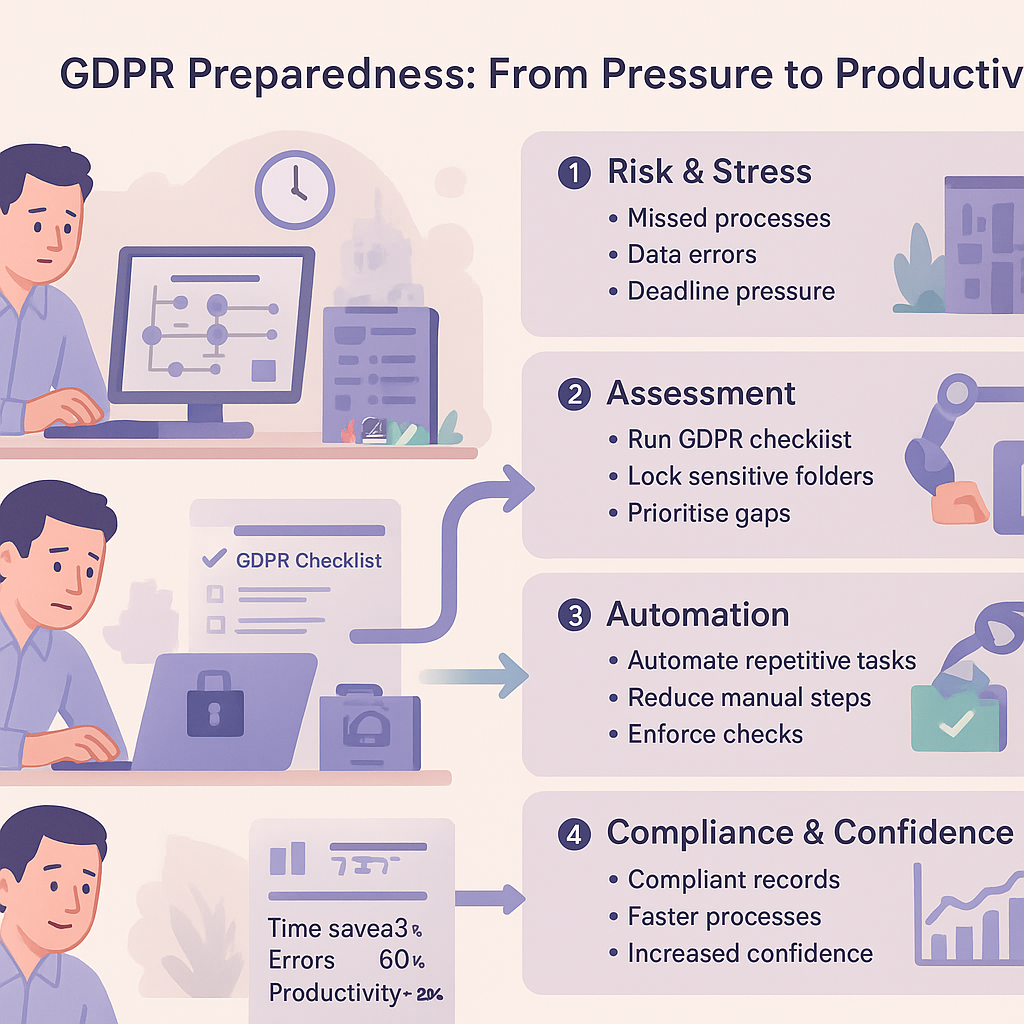
How to Build GDPR-Compliant Automation Workflows for UK Small Businesses: A Practical Guide
Automation promises efficiency for UK small businesses, but ignoring GDPR could lead to fines up to 4% of turnover and irreparable reputational damage.
Why GDPR-Compliant Automation Workflows Matter for UK Small Businesses
In today’s digital landscape, GDPR-compliant automation workflows UK small businesses enable efficient operations while safeguarding personal data and ensuring regulatory compliance.
Many small businesses adopt automation tools hastily, overlooking data protection risks such as unauthorised processing, inadequate consent, or prolonged data retention, which can result in significant penalties.
This practical guide outlines how to design, implement, and maintain secure automation workflows tailored for UK small businesses, balancing productivity with GDPR adherence.
GDPR Basics: What UK Small Businesses Need to Know for Automation
The UK General Data Protection Regulation (UK GDPR), enforced by the Information Commissioner’s Office (ICO), sets strict rules for handling personal data. For small businesses using automation, understanding core principles is essential to prevent violations from the start.
Key tenets include lawful basis for processing—such as consent, contract necessity, or legitimate interests—data minimisation (collect only what’s necessary), accuracy, storage limitation, integrity and confidentiality, and accountability. In automation, these apply directly: for instance, an automated email sequence must verify consent before sending personal data.
Post-Brexit, UK GDPR mirrors EU GDPR but with ICO-specific guidance. Small businesses often process data via tools like CRMs or marketing platforms, where automation amplifies risks if not designed compliantly. Embedding these basics ensures scalability without legal exposure.
- Lawful basis: Always document why you’re processing data (e.g., consent for marketing automations).
- Data minimisation: Automate only essential fields, like name and email, not full addresses unless required.
- Accountability: Maintain records of processing activities, even for automated systems.

UK GDPR Article 5 outlines principles: processed lawfully, fairly, transparently; purpose-limited; minimised; accurate; limited retention; secure; accountable.
- Review your current automations against the six GDPR principles.
- Document lawful basis for each data processing activity.
Common Mistakes in Automation Workflows That Breach GDPR
Many UK small businesses rush into automation without GDPR checks, leading to breaches. A frequent error is failing to verify consent at every workflow step, such as auto-sending newsletters to purchased lists without opt-in confirmation.
Another pitfall is collecting excessive data—e.g., capturing full profiles in lead forms when only email suffices—violating data minimisation. Lacking audit trails means no proof of compliance during ICO investigations, while insecure transfers to non-UK servers risk adequacy decisions.
Consequences are severe: ICO fines reached £4.4 million in 2023 for data mishandling. Breaches disrupt operations, erode trust, and invite complaints. Pausing workflows immediately upon detecting inaccuracies prevents escalation.
- No granular consent: Treating all data the same without step-specific checks.
- Over-retention: Automations keeping data indefinitely without deletion schedules.
- Ignoring DSARs: Automated systems not equipped to handle subject access requests promptly.

Stop workflows if consent fails, data inaccuracies appear, or regulatory changes occur. Review before resuming to avoid fines.
- Audit existing automations for consent verification.
- Implement automatic data deletion after retention periods.
Core Principles for GDPR-Compliant Automation Workflows
Building GDPR-compliant automation workflows UK small businesses requires embedding principles like data minimisation—design flows to use only necessary personal data—and purpose limitation, ensuring data isn’t repurposed without basis.
Transparency demands clear privacy notices explaining automations, while security by design incorporates encryption and access controls from inception. Automated consent management, such as double-opt-ins, ensures ongoing validity. UK GDPR emphasises these in retained EU law, with ICO stressing proportionality for small firms.
Practical examples: In CRM automations, tag leads only with consented data; for email workflows, include unsubscribe links that trigger immediate data purges.
- Data minimisation: Automate pseudonymisation where possible.
- Purpose limitation: Code workflows to reject off-purpose triggers.
- Security: Use HTTPS and role-based access in tools.
Integrate: Consent refreshers, data masking, breach notifications within 72 hours.
- Design with privacy by default.
- Test automations for principle adherence before launch.
Step-by-Step Guide to Building GDPR-Compliant Automation Workflows UK Small Businesses
Start by mapping your data flows: Identify all personal data touched by the automation, from collection to deletion. Assess risks with a simple Data Protection Impact Assessment (DPIA) if high-risk.
Next, integrate consent checks—use tools with built-in verifiers—and apply minimisation by stripping unnecessary fields. Build audit logs capturing every action with timestamps and user IDs.
Test rigorously: Simulate runs, check for leaks, verify deletions. Deploy with monitoring, and document everything for ICO proof. This approach suits small businesses using no-code platforms.
- 1. Map processes and data points.
- 2. Secure lawful basis and consents.
- 3. Minimise and pseudonymise data.
- 4. Implement logging and security.
- 5. Test compliance end-to-end.
- 6. Launch, monitor, and iterate.
Integrate: Consent refreshers, data masking, breach notifications within 72 hours.
- Complete DPIA for new workflows.
- Run compliance tests weekly initially.
Choosing the Right Tools for Secure Automation in the UK
Prioritise platforms with UK GDPR certification, data centres in the UK or EEA for adequacy, and features like granular consents, automated DPIAs, and exportable audit logs.
Evaluate vendor contracts for Data Processing Agreements (DPAs), processor accountability, and breach notification SLAs. Balance costs with compliance—free tiers often lack essentials.
Examples include no-code builders with native GDPR modules and UK-hosted CRMs. Use a scorecard: score on residency, features, support, and reviews from ICO-compliant users.
- UK/EEA data hosting.
- Built-in consent and audit tools.
- Transparent DPAs and certifications.
- Scalable for small business budgets.
Score 1-10: Compliance features (40%), UK focus (30%), Ease of use (20%), Cost (10%).
- Request DPA from vendors.
- Verify data residency in terms.
Auditing, Monitoring, and Maintaining Your Automation Workflows
Regular audits—quarterly at minimum—involve reviewing logs for anomalies, testing consent validity, and simulating DSARs. DPIAs update for workflow changes.
Implement retention policies automating deletions, train staff on spotting issues, and subscribe to ICO updates. Document all for accountability.
If inaccuracies arise or laws change, halt automations promptly, review, and restart compliantly. This sustains trust and efficiency.
- Schedule automated audit reports.
- Handle DSARs within one month.
- Update workflows for ICO guidance.
Unverified consents, data leaks, or outdated retention—pause immediately and audit.
- Conduct DPIA annually.
- Train team on GDPR automation basics.
- Review post-ICO announcements.
Achieve Compliant Automation for Long-Term Success
GDPR-compliant automation workflows UK small businesses deliver efficiency without compromise, protecting against fines and building customer trust through ethical data handling.
By applying core principles, following step-by-step builds, selecting right tools, and maintaining audits, you create robust systems that scale securely.
Consider a professional review of your setups to ensure full adherence—proactive compliance is key to sustainable growth in the UK market.
Key points
- GDPR-compliant automation workflows UK small businesses protect against fines while enhancing efficiency.
- Always verify consent mechanisms and minimise data collection in every automated process.
- Conduct regular audits and maintain detailed records to demonstrate compliance.
- Choose tools with built-in GDPR features and UK data residency options.
- Start with simple workflows, scale securely, and review processes amid regulatory changes.
Frequently asked questions
Can small UK businesses implement GDPR-compliant automation workflows?
Yes, small UK businesses can effectively implement GDPR-compliant automation workflows by embedding core principles such as data minimisation, lawful basis for processing, and accountability from the outset. The complexity depends on the tools used, data quality, and process clarity, but starting with simple mappings and no-code platforms makes it accessible without needing advanced technical expertise.
How do I ensure consent is properly verified in automated workflows?
To ensure consent is verified in automated workflows, integrate granular checks at every relevant step, such as double-opt-in mechanisms or real-time validation before processing personal data. Use tools with built-in consent management features and always document the lawful basis, allowing for easy withdrawal, which aligns with ICO expectations for transparency and user control.
What are the key GDPR risks when automating business processes?
Key GDPR risks in automation include unauthorised data processing due to missing consent checks, over-retention of personal data, and inadequate security measures leading to breaches. These can result in ICO fines, reputational damage, or operational disruptions, but risks are mitigated through regular audits, data minimisation, and compliance-focused tool selection tailored to UK regulations.
How often should small businesses audit their automation workflows for GDPR compliance?
Small businesses should audit automation workflows at least quarterly, or more frequently if changes occur, to review logs, test consent validity, and ensure adherence to principles like storage limitation. Frequency depends on workflow volume and risk level, with automated reporting tools helping maintain ongoing accountability as per UK GDPR requirements.
Will GDPR-compliant automation tools work with my existing business software?
Many GDPR-compliant automation tools integrate seamlessly with common business software like CRMs and email platforms via APIs or no-code connectors, provided data residency and security standards match. Compatibility varies by specific systems, so evaluate vendors for UK GDPR certifications and request Data Processing Agreements to ensure smooth, compliant integration.
Need Guidance on GDPR-Compliant Automation?
Let Business Automations UK review your processes and help build secure workflows suited to your small business needs. Contact us for expert advice on compliance and efficiency.
This article is for general information only. It is not legal, financial, or compliance advice. If you are unsure about GDPR, HMRC, or regulatory obligations, speak to a qualified professional or reach out to us for more information.
Related Posts
How to Automate Client Onboarding for UK SMEs: A Practical Guide

How to Automate Insurance Claim Processing for UK SMEs: Streamline Approvals & Reduce Admin

How to Automate Subscription Billing for UK SMEs: Reduce Churn & Streamline Recurring Payments
How to Automate Health and Safety Incident Reporting for UK SMEs: Streamline Compliance & Reduce Liability
How to Automate Purchase Order Approval Workflows for UK SMEs: Cut Delays & Boost Compliance
How to Automate Vendor Invoice Processing for UK SMEs: Speed Up Payments & Reduce Errors
How to Automate Invoice Payment Chasing for UK Small Businesses: A Proven 5-Step Guide
How to Automate Supplier Onboarding for UK SMEs: Streamline Procurement & Ensure Compliance

How to Automate Inventory Management for UK SMEs: Reduce Stock Errors & Boost Efficiency
How to Automate Risk Assessment Workflows for UK SMEs: A Compliance Guide
How to Automate GDPR Data Retention Policies for UK SMEs: Delete Personal Data Lawfully
How to Automate Compliance Training Tracking for UK SMEs: A Step-by-Step Guide
- How to Automate Client Onboarding for UK SMEs: A Practical Guide

- How to Automate Insurance Claim Processing for UK SMEs: Streamline Approvals & Reduce Admin
- How to Automate Subscription Billing for UK SMEs: Reduce Churn & Streamline Recurring Payments
- How to Automate Health and Safety Incident Reporting for UK SMEs: Streamline Compliance & Reduce Liability
- How to Automate Purchase Order Approval Workflows for UK SMEs: Cut Delays & Boost Compliance