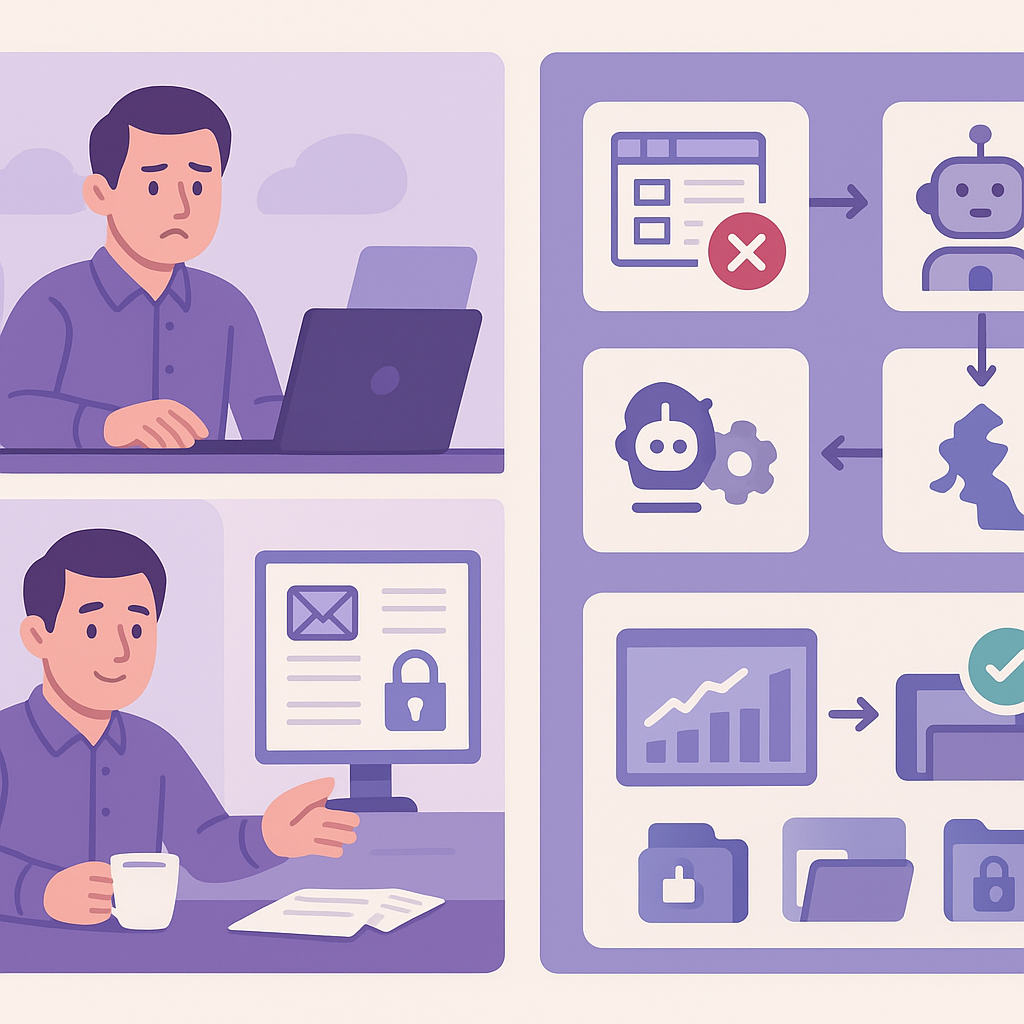
How to Automate HMRC Submissions for UK SMEs: Reduce Tax Filing Stress
Tired of late nights and error-prone spreadsheets battling HMRC deadlines as a UK SME owner? HMRC submission automation for UK SMEs can transform your tax filing from a nightmare into a seamless process.
Why HMRC Submission Automation is Essential for UK SMEs
HMRC submission automation for UK SMEs is revolutionising how small and medium enterprises handle VAT returns, PAYE submissions, and other tax filings, saving hours of manual work each quarter.
Manual processes lead to errors, missed deadlines, and potential penalties that UK businesses can’t afford, especially with Making Tax Digital mandates.
This guide walks you through the why, how, and best practices for automating HMRC submissions safely and effectively.
The Challenges of Manual HMRC Submissions
Manual HMRC submissions remain a significant burden for many UK small and medium enterprises (SMEs). Owners and finance teams often spend countless hours gathering data from disparate sources like invoices, payroll records, and bank statements, only to enter it into HMRC’s online portals or spreadsheets.
This process is not only time-consuming but also prone to human error. A simple transposition of figures or missed decimal point can result in incorrect VAT returns or PAYE filings, triggering HMRC penalties that range from £100 fixed charges to higher amounts based on the lateness or inaccuracy.
As businesses grow, the challenges intensify. What starts as a quarterly chore becomes overwhelming during peak periods, diverting attention from core operations and impacting cash flow. Many SMEs report that tax admin consumes up to 20% of their finance team’s time, leading to burnout and scalability issues.
- Excessive time spent on data collection and entry, often exceeding 10-20 hours per submission.
- High risk of errors leading to fines, interest, and even audits from HMRC.
- Difficulty scaling with business growth, requiring additional staff or external accountants.
- Stress from tight deadlines under Making Tax Digital (MTD) rules, with no room for delays.
HMRC imposes automatic £100 penalties for late VAT returns, escalating for repeated offences. Inaccurate submissions can lead to assessments and further costs—always double-check manual entries.
Key HMRC Submission Requirements for UK SMEs
UK SMEs must navigate a complex landscape of HMRC submission requirements, primarily driven by the Making Tax Digital (MTD) initiative. Since 2019 for VAT (threshold £85,000) and 2020 for Income Tax Self Assessment, businesses are required to keep digital records and submit returns via HMRC-approved software.
Key submissions include quarterly VAT returns, monthly or annual PAYE Real Time Information (RTI), and annual Corporation Tax returns. Deadlines are strict: VAT by the end of the month following the quarter-end, PAYE on or before the 19th of the following month.
HMRC mandates digital links between records and submissions, often via MTD APIs. Data must be accurate to four decimal places for VAT, with no manual overrides allowed post-submission without good reason. Non-compliance risks not just fines but also reputational damage and disrupted cash flow.
– VAT: Digital records and submissions from £90,000 threshold (rising).
– PAYE: RTI via FPS and EPS.
– ITSA/Corporation Tax: From April 2026 fully digital.
Always check gov.uk for updates.
- Confirm your MTD VAT registration status.
- Review submission deadlines in your HMRC calendar.
- Ensure software connects digitally to HMRC.
Benefits of HMRC Submission Automation for UK SMEs
HMRC submission automation for UK SMEs delivers immediate relief from manual drudgery, typically reducing preparation time by 70-90%. Accounting software like Xero or QuickBooks integrates directly with HMRC APIs, pulling data automatically and generating compliant returns.
Error rates plummet with built-in validation checks, ensuring figures match your books before submission. Automated reminders prevent missed deadlines, safeguarding against penalties and keeping your business on track.
Beyond compliance, automation provides real-time insights into tax liabilities, aiding cash flow forecasting. It scales effortlessly as your SME grows, without proportional increases in admin costs, allowing focus on revenue-generating activities.
- Save 10+ hours per quarter on tax admin.
- Reduce errors by up to 95% with automated validations.
- Ensure always-on compliance with MTD and digital linking.
- Gain scalability and cost savings—no need for extra hires.
- Enjoy peace of mind with audit trails and instant HMRC confirmations.
Choosing the Right Tools for HMRC Submission Automation
Selecting the right tools for HMRC submission automation starts with verifying MTD Phase 1 and 2 compatibility. Look for software certified by HMRC, such as Xero, QuickBooks Online, FreeAgent, or VT Transaction+ , which offer seamless API connections.
Prioritise GDPR-compliant platforms with robust data security, especially since tax data is sensitive. Ease of setup, intuitive dashboards, and UK-based support are vital for SMEs without dedicated IT teams.
Consider costs: many start at £10-50/month, with free trials. Test in HMRC’s sandbox environment to simulate submissions without risk. Integration with your existing accounting or payroll systems amplifies value.
Popular choices: Xero (strong integrations), QuickBooks (PAYE focus), FreeAgent (SME-friendly). Always verify current HMRC bridging status.
- HMRC MTD API certification (VAT, PAYE, ITSA).
- GDPR compliance and data encryption.
- User-friendly interface and mobile access.
- Affordable pricing with scalable plans.
- Excellent customer support and regular updates.
Step-by-Step Guide to Setting Up HMRC Submission Automation
Setting up HMRC submission automation begins with registering for MTD if not already done via your HMRC online account. Authorise your accounting software as an Agent or use Government Gateway credentials.
Connect via HMRC APIs: most tools guide you through OAuth authorisation. Map data fields—e.g., VAT sales to Box 1, ensuring digital links from source records.
Test thoroughly: submit sample returns in sandbox mode, verifying outputs match expectations. Once validated, schedule live automations with pre-submission approvals.
Go live with monitoring: review first few submissions manually, then automate fully. Troubleshoot common issues like API rate limits by batching data or contacting support.
- 1. Register/enrol for MTD VAT/PAYE in HMRC portal.
- 2. Choose and sign up for MTD-compatible software.
- 3. Link accounts via API keys or Government Gateway.
- 4. Import/map historical data accurately.
- 5. Test in sandbox: simulate full VAT/PAYE cycles.
- 6. Submit live, review HMRC acknowledgements.
- 7. Set up alerts for errors/deadlines.
Mismatch in data mapping can cause rejections. Always reconcile automated outputs with your records before authorising submission.
- ✅ MTD enrolled?
- ✅ Software linked?
- ✅ Sandbox tested?
- ✅ First live submission reviewed?
Managing Risks and Ensuring Compliance in HMRC Automation
While powerful, HMRC submission automation requires vigilance. Always verify data pre-submission against source documents to catch discrepancies from integrations or changes.
Monitor HMRC updates via newsletters or software alerts—e.g., API changes or MTD expansions. Maintain GDPR compliance by limiting data access and using encrypted connections.
Conduct quarterly audits: sample check 10% of submissions. Have a manual fallback process for outages. Pause automation if errors occur until resolved.
These steps minimise risks like penalties (£100+ for inaccuracies) or data breaches, ensuring your SME remains compliant and protected.
- Regular data reconciliations and audits.
- Subscribe to HMRC MTD updates.
- Backup manual processes for contingencies.
- Train staff on approval workflows.
- Use role-based access for security.
Never submit unverified automations. HMRC can impose penalties up to 100% of tax due for careless errors. Pause if discrepancies >1% or HMRC rejects filings.
Take Control of Your Tax Filings with Confidence
HMRC submission automation for UK SMEs isn’t just a convenience—it’s a strategic necessity in the Making Tax Digital era. By addressing manual challenges, meeting compliance demands, and leveraging the right tools, you can eliminate stress and errors from tax filings.
Follow the steps outlined to implement a reliable system that saves time, reduces risks, and supports your business growth. Remember to prioritise verification and ongoing monitoring for sustained success.
Consider consulting a specialist for tailored setup, ensuring your automation aligns perfectly with your operations and HMRC rules.
Key points
- Manual HMRC submissions drain time and risk costly errors for UK SMEs—automation changes that.
- HMRC submission automation for UK SMEs ensures compliance with Making Tax Digital while slashing admin burdens.
- Choose tools with proven HMRC API integrations and GDPR safeguards for peace of mind.
- Test thoroughly in sandbox mode before live submissions to avoid penalties.
- Implement now to reclaim hours for business growth and focus on what matters.
- Regular audits and monitoring keep your automations reliable and compliant.
Frequently asked questions
Is HMRC submission automation suitable for small UK businesses?
Yes, HMRC submission automation is well-suited for small UK businesses, including sole traders and SMEs, as long as they meet Making Tax Digital thresholds. It integrates with common accounting tools to handle VAT and PAYE submissions efficiently, reducing manual effort while ensuring compliance. The suitability depends on your current processes, data quality, and choice of HMRC-approved software.
How long does it typically take to set up HMRC submission automation?
The setup time for HMRC submission automation varies based on your existing systems, data readiness, and software chosen. Simple integrations might take a few hours, while more complex mappings could require days. Always test in HMRC’s sandbox environment first to validate without risk.
Will HMRC automation work with my existing accounting software?
Many popular UK accounting packages like Xero, QuickBooks, and FreeAgent are HMRC MTD-compatible and support API integrations for automated submissions. Check HMRC’s list of approved software and test compatibility with your specific setup to ensure seamless data flow.
What are the GDPR risks with HMRC submission automation?
GDPR risks arise if automation tools mishandle sensitive tax data, but reputable HMRC-approved software includes encryption and access controls. Choose GDPR-compliant providers, limit data sharing, and conduct regular audits to protect personal information in line with ICO guidelines.
What should I do if an automated HMRC submission fails or contains errors?
If an automated submission fails, immediately review the error from HMRC, reconcile data against source records, and resubmit corrected information. Pause automation until resolved, use manual fallback if needed, and update your workflows to prevent recurrence.
Ready to Simplify Your HMRC Submissions?
Contact Business Automations UK for expert advice on tailoring HMRC submission automation to your SME’s needs. We’ll help review your setup and ensure compliance without the hassle.
This article is for general information only. It is not legal, financial, or compliance advice. If you are unsure about GDPR, HMRC, or regulatory obligations, speak to a qualified professional or reach out to us for more information.
Related Posts

How to Automate Client Onboarding for UK SMEs: A Practical Guide


How to Automate Insurance Claim Processing for UK SMEs: Streamline Approvals & Reduce Admin

How to Automate Subscription Billing for UK SMEs: Reduce Churn & Streamline Recurring Payments
How to Automate Health and Safety Incident Reporting for UK SMEs: Streamline Compliance & Reduce Liability

How to Automate Purchase Order Approval Workflows for UK SMEs: Cut Delays & Boost Compliance
How to Automate Vendor Invoice Processing for UK SMEs: Speed Up Payments & Reduce Errors

How to Automate Invoice Payment Chasing for UK Small Businesses: A Proven 5-Step Guide

How to Automate Supplier Onboarding for UK SMEs: Streamline Procurement & Ensure Compliance

How to Automate Inventory Management for UK SMEs: Reduce Stock Errors & Boost Efficiency
How to Automate Risk Assessment Workflows for UK SMEs: A Compliance Guide

How to Automate GDPR Data Retention Policies for UK SMEs: Delete Personal Data Lawfully

How to Automate Compliance Training Tracking for UK SMEs: A Step-by-Step Guide
- How to Automate Client Onboarding for UK SMEs: A Practical Guide

- How to Automate Insurance Claim Processing for UK SMEs: Streamline Approvals & Reduce Admin
- How to Automate Subscription Billing for UK SMEs: Reduce Churn & Streamline Recurring Payments
- How to Automate Health and Safety Incident Reporting for UK SMEs: Streamline Compliance & Reduce Liability
- How to Automate Purchase Order Approval Workflows for UK SMEs: Cut Delays & Boost Compliance